International Men’s Day: The lessons I hope to teach my boys as a widowed dad
November 2026
To mark International Men’s Day, former WAY member Barney reflects on being a positive role model for his boys as a widowed dad…
“You deal with today, then tomorrow, and gradually a new life forms around you.”
“My wife Holly died by suicide in December 2016. I was 35 at the time. Our eldest son, Felix, was only four and Rufus was just 16 months old.
It was obviously an enormous shock, but alongside my own grief there was immediately the reality that I was now the only parent to two very young children – and running a camping business.
How did you and your boys cope with the first few weeks and months of bereavement?
I mainly remember trying to keep some form of normality around the boys. Rufus was only 16 months old, so in some ways that was easier because he wasn’t really aware of what was happening. Felix was four and very much knew that his mummy wasn’t there anymore. He would get upset because he couldn’t see her, and at that age there is only so much you can explain about why somebody has died and why they aren’t coming back. That was incredibly difficult.
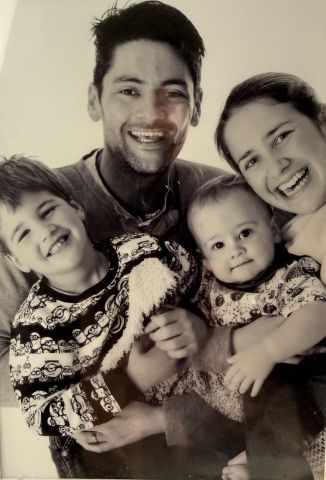
Three months after Holly died, just before our camping season started again at Easter, we went away on a family holiday with my parents, my auntie and my cousin. I think we all needed a change of scene and a bit of a reset before normal life and work started again.
Once the camping season began, the practical reality became much harder. I was running the business while also dealing with nursery, school, pickups and two very young children.
I eventually employed a nanny, who stayed with us for several years. Rufus was at private nursery and Felix was at the local school nursery, and having somebody who could bridge all those gaps was enormously important.
What were the additional challenges of being widowed to suicide and how did you support the boys through this?
One of the hardest things about suicide is that there are questions that don’t necessarily have satisfactory answers, even for adults, never mind a four-year-old.
Felix knew his mummy had gone and wanted to know why he couldn’t see her. At four, you have to try to be honest while also explaining something at a level a child can understand.
For me, the priority was always making the boys feel safe and maintaining as much normality as possible. Their world had changed completely through no choice of their own, so I tried to make sure everything else around them stayed as secure and predictable as it could.
I’ve always been quite open about Holly and her death. I don’t think hiding it or treating it as something shameful helps anybody. Obviously, the conversations have changed as the boys have grown older and have been able to understand more.
What support did you find most helpful in those earliest days?
I was extremely fortunate that my parents lived next door and my cousin, who I’m very close to, was only a few miles away. My wider family and friends were incredible. People genuinely offered to do whatever they could. I was also extremely blessed that Holly was a paramedic, so she had a large circle of friends in the NHS who helped support me.
Later, having a nanny became invaluable because it wasn’t only emotional support I needed – it was practical support. Somebody had to collect children, look after them and enable me to continue running the business.
What does still surprise me is that there was effectively no proactive support from the NHS or my GP. Nobody contacted me afterwards to ask how I was coping or whether I needed support. Friends of mine who are GPs have since been horrified when I’ve told them that.
I eventually arranged private counselling, which I paid for myself, and later reached out to organisations including Cruse and WAY.
How did WAY’s peer support network help you?
I found WAY later rather than immediately after Holly died and used the peer-support network, particularly through social media. There is something completely different about talking to people who have actually experienced young widowhood. However supportive friends and family are, there are parts of it that are difficult to understand unless you have lived through it.
A few years ago, I also offered a free camping weekend at my campsite, The Hideaway at Baxby Manor, for WAY members. It felt like a nice way of giving something back and bringing people together somewhere relaxed where nobody needed to explain why they were there or what they had been through.
What were the additional challenges of being male and widowed, and how have you coped as a widowed father to two boys over the past nearly ten years?
I think there is still an expectation that men will just get on with things. I’m actually very open about my emotions and will talk openly about Holly, her death and what life was like before and afterwards. But I sometimes think other people hold back.
There can almost be a strange reverse psychology around offering help to a man. People perhaps think, “He’s capable, he runs his own business, I don’t want to insult him by asking whether he needs help.”
I suspect some of those assumptions would have been different if I had been a widowed mother. The reality was that I needed help just as much as anybody else would have done.
Running and building a business is enough for most people. Having to do that while also suddenly filling both parenting roles for two young boys was something I could never have imagined doing.
If somebody had asked me while Holly was alive whether I could cope with that, I would probably have said, “Not a chance.”
But when it happens, you don’t really have a choice. You adapt. Eventually something that once seemed completely impossible becomes your new normal. Like managing a business, laundry, shopping, cooking meals, housework, clearing up after the boys (!), and helping with homework all at once, for example!
What have you been most proud of over the past ten years?
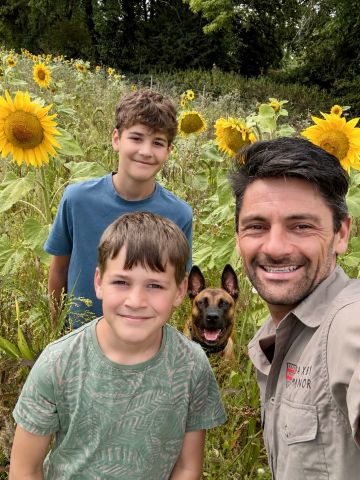
Probably the fact that the three of us have adapted and kept going. I’m not going to pretend it has been a walk in the park. Alongside losing Holly, I have had significant health problems myself over the years, and running and developing a business while raising two children alone has been really hard at times.
But Felix and Rufus are two beautiful boys who I’m enormously proud of. When I look at them now and see the young men they are becoming, I know Holly would be incredibly proud of them too. That matters far more to me than anything I’ve achieved in business.
How important is it to provide a positive role model to your sons?
Extremely important. One thing I hope I’ve shown them is that being a man doesn’t mean pretending you don’t have emotions.
I talk about how I feel. I talk about Holly. I’m not embarrassed to be upset and I don’t want them growing up thinking strength means shutting everything away.
At the same time, I hope they have also seen that when life changes completely, you can adapt and keep building something meaningful.
For me, resilience isn’t about being unaffected by what happens to you. It is about being affected by it and still finding a way to continue.
Life certainly hasn’t followed the route I imagined when Holly was alive, but we have built a life around what happened rather than allowing what happened to become our entire life.
Do you have any advice for widowed dads raising boys on their own?
The biggest thing I would say is that you don’t have to prove anything by doing everything yourself. Accept practical help. Sometimes somebody collecting a child from school, making dinner or taking them out for a few hours is far more useful than somebody simply asking how you are feeling.
And if someone says, “Can I help somehow?”, your automatic response is often, “Aw, thanks, that’s really kind, but I’m good.” I know that was certainly true for me.
Looking back, I wish people had sometimes been more definite rather than making an open-ended offer. Something like, “I’m taking the boys tomorrow at 10am for a few hours” is much easier to accept than, “Let me know if you need anything.”
When you’re grieving, you often don’t have the energy to work out what help you need, ask for it, or feel comfortable imposing on someone. Sometimes the most helpful thing another person can do is simply take one small decision off your hands.
Keep some routine around the children when you can. When everything else has changed, ordinary things can provide a huge amount of security.
Be honest with them, but in a way that’s appropriate to their age. As they grow older, their understanding changes and the conversations can grow with them.
And don’t feel that being their dad means you have to be permanently strong.
Your sons seeing you upset doesn’t make you less of a father. If anything, I think showing them that men can talk about grief, fear and emotion is part of raising emotionally healthy boys.
Most importantly, don’t look too far ahead. If somebody had shown me the next ten years immediately after Holly died, I probably would have wondered how on earth I was going to manage it. But you don’t live ten years in one go. You deal with today, then tomorrow, and gradually a new life forms around you.”

Your donations are always welcome.
Donate