Marking Children’s Grief Awareness Week: Sharing Stories, Strengthening Hope
November 2025
To mark Children’s Grief Awareness Week, WAY member Alex shares his story of being a widowed dad to two children – one of whom has Down's syndrome – and explains how WAY helped him to find a more hopeful future…
“My wife, Nina, died from a rare lung cancer early in 2023 at the age of 47. The cancer had been under control for two of the three years she was ill, but devastatingly, her treatment led to encephalitis, which caused her to lose her physical ability and then her mental capacity. It was like watching a 10-year dementia journey unfold in 10 weeks. Nina was an amazing woman – a formidable force in finance who studied maths at Cambridge and ran marathons competitively for fun. Losing her, particularly in that horrible way, was incredibly tough.
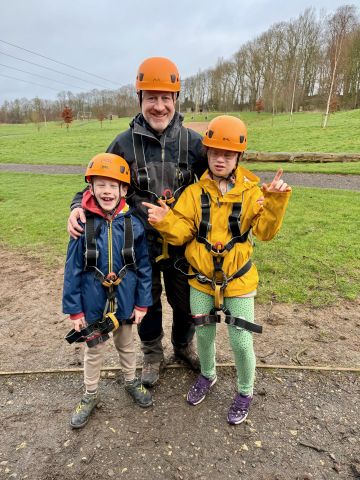
We have two children – Harvey, who was seven, and Ella, who was ten when Nina died. They’ve coped incredibly well, but Ella has Down's syndrome and found it hard to understand the permanence of death.
I cared for Nina full-time for six months before she died. I was already the glue at home, doing all the kids’ stuff too. So, when she passed away, there wasn’t that sudden shock of having to pick everything up from scratch – there was a kind of continuum. I took three months off work from Cranfield University, where I still work, and they’ve been amazing with the flexibility they’ve given me.
Even so, doing it all on your own is incredibly hard, particularly with two grieving children. Being a solo parent is very different from being a single parent when the other parent is still around. You have to do everything, all the time.
I’ve thought a lot about how being a dad – and a man – shapes this experience. I’ve always been very hands-on. I even took the second half of shared parental leave when Harvey was born.
Some dads I’ve met through WAY didn’t even know where their kids were dropped off at school or when they had PE. I was completely immersed in all that, which actually prepared me quite well for parenting two grieving children – I already knew what needed doing day to day. But even with that, it’s tough.
When I’ve had really bad days, I’ve tried to open up to male friends, but they often don’t know what to say. They just look deeply uncomfortable. That’s why the relationships I’ve built with other widowed people mean so much.
Finding WAY
I joined WAY just a few weeks after Nina died – before her funeral, in fact. I was completely lost and needed to be around people who understood the pain and difficulty I was feeling. The support from my local group was a complete surprise and incredibly helpful for me. No one – not my GP, not even Maggie’s – had mentioned WAY; I just found it by Googling bereavement support.
My first meet-up was a lunch near Cambridge station. I was like a rabbit in the headlights and shocked by how many young widowed people there were. Seeing 20 or so people around the table, some younger than me at 43, was sad – but also strangely hopeful.
The people who were 18 months on from their loss was the most important thing for me. You can see they’ve found a bit of stability, that they can smile and laugh again. It doesn’t mean you “recover”, but it gives you hope that it gets better. Now, I go to events to be that person who is a couple of years down the link and is doing OK. I try to make the monthly Cambridge lunch, and, if I can get a babysitter, I go to the adults’ evening meet-ups.
I’ve also been to a PGL activity weekend and a Father’s Day gathering on the Dorset coast with Harvey and Ella. Having people around who just get it without you needing to explain is incredibly helpful.
Navigating schooling and special needs
My main focus since Nina died has been the children. They’ve needed me more than anyone else. It has helped me immeasurably in ensuring they are fully supported and doing well. We’ve had to navigate several school changes in that time.
Ella started mainstream secondary school in September 2023, the same year Nina died. It was a disaster. Because she has Down's syndrome, she was basically segregated for a year. Her anxiety skyrocketed – she pulled her hair out, picked at her skin until it bled, and stopped speaking altogether. After an emergency review, she started at a special school last September, and it’s been a total transformation. Her speech has come on in leaps and bounds.
Throughout Nina’s illness and after her death, both my children and I have had support from Maggie’s through art therapy. I still attend a monthly group for bereaved parents, which also offers bereavement support for children. It’s more structured than WAY, which is all peer-to-peer, but the combination of both has been fundamental in helping me cope and parent effectively.
The biggest challenge now is logistics. On work days, the school run alone can mean three hours in the car. We’re up at six and not home until after six – it’s a real slog. So, we’re putting the house on the market and plan to move closer to Ella’s school.
I’ve also become a parent governor at Ella’s school – something I couldn’t have imagined taking on after Nina died. But with the support of my employer and new friends through WAY, my confidence has grown again.
For other widowed parents, my advice is simple: know about WAY, join WAY, and go to the meet-ups. The hidden value lies in the subgroups – for me, the “widowed with children” group has been a lifeline. When your confidence is low or you’ve had a bad day, that support is right there when you need it.
Ultimately, I needed WAY, and it really helped me. I encourage anyone who’s struggling to get involved.”

Your donations are always welcome.
Donate