Dying is an expensive business: An essay to mark International Women’s Day
March 2026
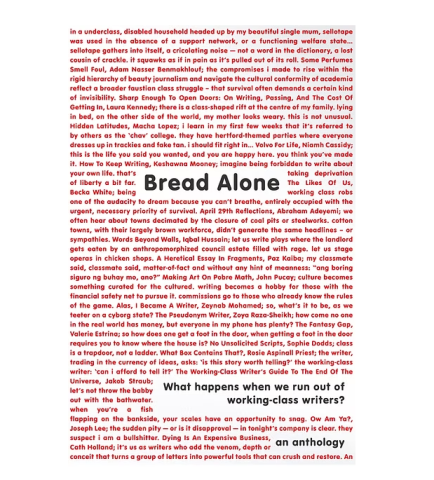
When Cath Holland’s husband died, she realised dying was an expensive business; as a newly widowed woman, continuing to work as a freelance writer wasn’t practically or financially viable. Ahead of International Women’s Day, she shares an exclusive extract of her essay in the forthcoming anthology about writing & social class entitled Bread Alone….
“In the dying weeks of 2018, 11 months from an initially, fully treatable cancer diagnosis, my husband Andy entered palliative care. It came as a savage shock after the original prognosis of us living through ‘a rocky few months’. Tumours are cruelly unpredictable and have a defiant will of their own, as it turns out. After the life-changing, life-ending news, it soon became clear how caring for and supporting my dying spouse of 24 years, counting painkillers and emotions and district nurse visits and blue light hospital dashes, is not compatible with sustaining a freelance writing career.
The fantasy image of writers living fat and happy and free-spirited on words alone is a sepia-tinged nostalgia for most. As I’m writing this, I’ve had notice from a publisher that a book from 2019 I have a short story in has been used for free by Meta in order to train AI. Regard for copyright, which demands consent and money for use of a writer’s work, is becoming an optional extra.
While we’re talking fantasy, the trope of the wealthy Bridget Jones widow is for Hollywood. We are not all celebrity widow influencers or have life insurance payouts taking the edge off or providing relief. Savings wither away at an alarming rate. With no luxury of time to think and plan, we must get on and make do, all the time slowed by widow brain fog. They don’t tell you about that in the leaflets. Bereavement costs on every level – financially, emotionally, contacts-wise are more secondary losses to add to the list.
In traditional societies working-class widows often live in poverty, the women themselves seen as bad luck by the community in which they live, and in some cultures blamed for her husband’s death, her fate to be ‘cleansed’ by rape and if she owns anything of value, be the victim of property grabbing. Historically widows have been forced to marry their late husband’s brother and viewed as a burden.
Two incomes became none
Contemporary women in the UK may not experience irrational extremities such as these, but we are forced into a life different from before, emotionally and materially. After Andy’s illness then death, two incomes became none. We’ve all heard two can live as cheaply as one. All very well when your husband is alive. If he’s dead, not so much. Mortgage payments are still the same, as are utility bills, home maintenance, everything. When we bought our house, we did so with two incomes in mind and had a lifestyle to match. His illness and death set me back on a number of levels, took me down a peg or two. You do everything you’re meant to, attentive at school, go to university, then return to pursue a postgraduate degree to improve one’s writing prospects in the creative sphere, focus on being the best you can be and still it doesn’t work out because life not so much throws you a curveball, but punches you right in the face with multiple blows.
I can only write from a woman’s point of view and experience here, but women and men, widows and widowers, face differing challenges and have unique vulnerabilities. On average men earn more money than women, meaning a financial disadvantage is there before insecurity of income is even factored in. And we must not ignore that women become less visible as we reach middle age, and our basic biological function ceases. Working-class women become invisible first. For true equality to be achieved, feminism must intersect with areas it typically does not regard of value or relevance. Blending class with one’s feminism earns few cool points but must be considered, and stereotypes connected to those from the working-class comprehensively reassessed, material disadvantages and confidence levels factored in and worked on positively.
Class and money either widen options and opportunities or close the door with a deafening and definite slam. The higher up the social scale people originate, the more doors held open by the firm knot of that old school tie – the class equivalent of nepo baby privilege – and the safety net better conserved.
“My options narrowed after widowhood”
As a new widow I took on agency admin work that I was overqualified for but not too proud to take. Job satisfaction for a while became a concept. I treaded water for a while as I recovered from bereavement. I had to start again and set about finding another way to earn a living which had some connection or relevance with what was on my CV. My writing and media work gave me the background to facilitate a career change post-loss, a step assisted by a mentor passionate about social mobility.
She helped me navigate a complex and challenging and unfamiliar, formal application process. Job interviews are a curious, stressful experience, aren’t they? Virtual ones even more so. I had the skills and experience to make the shift but help and insight was essential. I consider myself fortunate for this. Sadly, a mentor can’t magic the water into wine – or in my case, the miracle of making freelance writing viable. Not in the current climate and for a woman living solo. But I’m now employed in a related field.
Additionally, in 2024 I had an accident which left me with a badly dislocated shoulder and injured leg. I was unable to work for five weeks but recognised my good fortune in being in a permanent PAYE role. I was able to take the time off sick with full salary paid. An alien concept to the self-employed. A positive luxury! Had I been freelancing as a single, working-class widow, it would have been even more impossible during this period to maintain a competent workflow and pace, and therefore income. A time of extreme anxiety, for certain. My comms job gives me a protective layer of security and stability. Such a move was never on my bucket list, my options narrowed after widowhood, but security much like growing older, is a privilege denied to many from my background.
My life – albeit one I didn’t ask for – feels more balanced than 2018 indicated it ever would be. I’m cautiously optimistic. I’ve had to compromise, though. A substantial amount. My very existence is different now. When your husband dies, everything is strange and new, nothing is familiar or warm. A massive emotional blow. I was never able to recover my writing career. Writing, creating with words has always been my companion. I actively put time aside to write and am fiercely protective of it, but my output is much reduced.
Dying is an expensive business, I have found, and costs considerably more than I anticipated. In more ways than the obvious.”
You can read WAY member Cath’s essay in Bread Alone, published on 9 March 2026 by Indie Novella, available in paperback for £10.99.

Your donations are always welcome.
Donate