Life after suicide loss: Lusu’s story
September 2026
WAY member Lusu shares her story and talks about how she has started rebuilding her life since her husband died by suicide in October 2025…
“Stephen died on 21 October 2025 while I was at work. He was supposed to go for an appointment, because he had been in severe pain with his teeth for a while. This was his final treatment and he was anxious about it. I had arranged for his friend to pick him up and take him to the dentist. I sent him a message saying, ‘Good luck today, don’t worry about it, you’ve got all the pain relief, you’ll be fine.’ Then he responded that his appointment had been cancelled. I said, ‘Don’t panic, don’t worry. Tomorrow I’m off, we can go to the dentist together.’

After that he did not respond. I saw that he had transferred some money into our joint account but I was busy at work (I work as a receptionist and administrator in a local GP surgery) and I didn’t have time to stop. At lunchtime I called him, but he didn’t answer. Later his best friend called me and said Stephen was not answering his phone and they didn’t know where he had gone. My heart just dropped.
I left work straight away and called the police because I was concerned about Stephen’s wellbeing. He had been very low with the pain from his teeth. He worked from home and, when I arrived there, his computers were turned off and the office lights were off too. Something didn’t feel right. I turned on the lights and found a note. It said he could not do this anymore because he was in so much pain. Over four or five pages, he wrote everything out: every detail of our marriage and how happy he’d been with me over the past 14 years and with Grace, messages to his mum, his brothers and his friends, details of the bills and all the accounts I needed and contact numbers to inform work.
The police came. Everyone was looking for Stephen. I kept saying he had gone to the woods according to the last message he had sent to friends, but I was told to stay at home because officers were coming to the house. Later Stephen’s nephews found him in the woods. I remember them screaming on the phone. The police came and confirmed that the body they had found was my husband. That’s when I collapsed on the floor and started to be violently sick. Later that evening, I had to sit down with Grace, who was just eight years old, and tell her that her Daddy had died.
I was in shock. The next day. I was getting calls from the coroner and I could not really grasp what they were trying to tell me. They asked if I could nominate someone I trusted who could be with me and retain the information because it was important. My best friend started speaking on my behalf. I just could not believe I was arranging a funeral for my 51-year-old husband. Just a few days before we had been laughing and joking and had even agreed on booking a summer holiday.
After the funeral, the reality hit
I am originally from Malawi and, in our culture, when someone has died people get together for a few days. They support you. Some of my friends were cooking, some were going shopping, and people put money together and did everything for the next few days. It was a comfort.
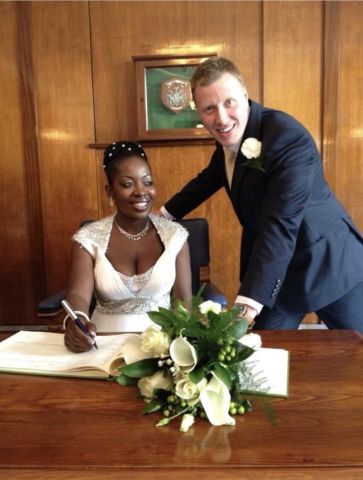
After the funeral, that is when the reality really hit. Everybody goes on with their life, which is fine because people cannot stay with you forever. It was quite shocking when it was just the two of us. Grace was upset and I was trying to manage her feelings as well as my own. I don’t know how I did it.
I took some time off work. I didn’t go back until April. I couldn’t sleep or eat, and I had memories of that day. I kept thinking, ‘Did I miss something’? But I had to make sure Grace was fine. I had to get up, make sure Grace went to school, make sure she ate. Grace has given me the motivation that I needed because she needs to be looked after.
I never used to drive. I could not keep taking taxis because it was so expensive, especially with school runs in winter. I needed to learn how to drive, and at the same time I needed to focus on something. I did my driving lessons and passed first time in June. We managed to get a small car – Stephen’s best friend helped us choose the right car because I had no idea.
Stephen’s friend and his wife also helped me sorting out all the admin and bills. Stephen was the main breadwinner and managed most of the big bills, like the mortgage. I sat down with the list of bills and worked out what I needed to get rid of, like Netflix, YouTube, Spotify and things we did not really need to pay for. I reduced what I could. Someone introduced me to Bereavement Support Payments, which is paid out for 18 months if you’ve been widowed. That has been really helpful but it will stop after 18 months.
Finding people who understand
The same friend told me about WAY and said, ‘you need to join this because it is a community and you are not on your own’. I became a WAY member in December and joined the Wednesday new member Zoom meetings. Later I also joined WAY’s subgroup for people who have been bereaved to suicide. Hearing other people’s stories was really helpful. When I was listening, it felt like someone else was talking through everything I was going through.
I also started walking. My motivation was that I needed to go and see Stephen’s grave, so I would walk there, then go to a café nearby, get a book, sit down, read it and walk back while Grace was at school. Walking turned to running and I registered to take part in a 10K run in memory of Stephen, and lots of us did it together earlier this year. It was really emotional.
This June, I climbed Mount Snowdon because I needed a challenge to keep going for. On Sunday, 13 September, I finished my first half marathon, the Great North Run, to raise funds for Cruse Bereavement Support, the day before Stephen’s birthday. I finished it in his memory. It was hard but he carried me through.
Today, my emotions are up and down but I can see how far I’ve come despite the exhaustion, stress and anxiety I sometimes get. There’s no time limit to grieve. The pain and the heartbreak is immense but sometimes the sadness comes with the good memories we created together.
What I’m looking for in the future is to keep channelling my grief energy into the challenges I can achieve. This doesn’t mean I’m leaving Stephen behind but I’m trying to focus on some positivity for the future to make sure Grace still grows up with some good memories. This is a long journey. Big waves of grief can be overwhelming but they can be conquered one step at a time.
Sharing advice
There is taboo regarding someone who has died by suicide. People can sometimes gossip and start rumours that are not true. It can feel like people are staring at you.
When someone has died by suicide it is not a crime, but people take it differently to someone who has died due to a physical illness. Dying by suicide is also an illness; it is mental illness. I had to learn how to navigate my emotions and my daughter’s emotions and block the outside noise.
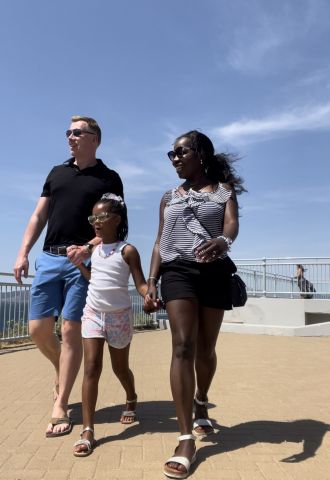
One of my first thoughts when Stephen died was ‘how am I going to explain to Grace how her daddy died’? She is too young to understand suicide. I was advised there are books I could read to explain to a child to understand what suicide is. I read the book and came to tell Grace. I was nervous and words couldn’t come out. Finally, I found the courage and explained to Grace. I was prepared to answer her questions, but she just looked at me and said ‘Oh, OK Mummy. Can I go play Roblox now?’.
I tried to bring it back up but she didn’t want to talk about it. I didn’t want to force her so I stopped asking if she would like to ask me anything or talk about Daddy.
I encouraged her to journal some messages to Daddy, which she did frequently. Now we talk about Daddy’s memories. What Daddy liked, Daddy’s songs, even simple things have now become a memory. When I am sad, Grace comes to me and says ‘Mummy, are you missing Daddy?’ She sees me crying she comes and gives me a big hug.
Being a child, she doesn’t know how to explain her emotions but I know when she is sad or struggling. She plays up or cries for no reason. I give her a hug and tell her it’s OK not to be OK. I bought her a few books regarding losing a parent, which we have been reading together.
It’s important to learn how not to blame yourself. Let yourself talk about the person who has died, look at pictures, videos you created together, remembering the good times.
You don’t have to answer everyone’s questions (it’s OK to say ‘I don’t want to talk about what happened). I had to learn how to put boundaries to friends and family.
Last but not least, always choose the right people to be in your circle of friends who can help you. I’ve learnt to choose the right people to be in mine. I have a group of friends who have been through everything with me and they usually arrange activities for us, which I join when I feel able to – but I don’t feel forced to do so.”
Useful books about explaining death by suicide to children
- The Invisible String by Patrice Karst and Joanne Lew-Vriethoff
- Let’s Talk about It: A guide for talking to children after a suicide of a loved one by Laura Camerona

Your donations are always welcome.
Donate